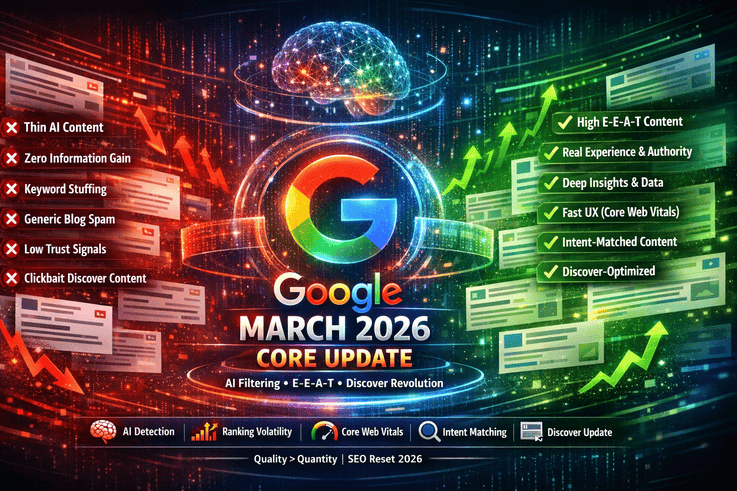
Google March 2026 Core Update: What Changed, Who Got Hit, and How to Recover Fast
The Google March 2026 Core Update began rolling out on March 27, 2026 and it is already shaking up search results across almost every industry. This is Google’s first broad core update of 2026. According to the Google Search Status Dashboard, the rollout can take up to two full weeks to complete.
If your rankings or organic traffic moved after March 27, this guide will tell you exactly why and exactly what to do about it. We have covered every angle based purely on Google’s official documentation so you are not guessing.
What Is the Google March 2026 Core Update?
A Google core update is a broad, significant change to how Google’s search algorithm evaluates and ranks content across the entire web. These are not targeted spam actions or minor bug fixes. They are full-scale reassessments of which pages genuinely deserve to rank at the top of search results.
According to Google’s core updates documentation, core updates are publicly announced because they introduce changes significant enough to cause noticeable ranking shifts across a wide range of websites. Some sites go up. Some go down. Many stay flat. The direction your site moves tells you something important about how Google currently values your content quality.
What makes the March 2026 core update unusual is the context surrounding it. Three separate algorithm events landed within roughly 30 days:
- The February 2026 Discover Update ran from February 5 to February 27, 2026
- The March 2026 Spam Update ran on March 24 and 25, 2026
- The March 2026 Core Update started rolling out on March 27, 2026
This kind of stacking is rare. Many site owners are seeing ranking volatility driven by more than one of these events simultaneously, which makes it harder to identify the actual cause of a traffic drop. Before you start making changes, you need to correctly diagnose which update caused which movement on which pages.
Timeline of Recent Google Core Updates
Knowing where the March 2026 update fits within Google’s update history helps you benchmark your site’s performance against the right baseline.
| Core Update | Start Date | End Date |
|---|---|---|
| March 2026 Core Update | March 27, 2026 | Up to 2 weeks (ongoing) |
| December 2025 Core Update | December 11, 2025 | December 29, 2025 |
| June 2025 Core Update | June 30, 2025 | July 17, 2025 |
| March 2025 Core Update | March 13, 2025 | March 27, 2025 |
| December 2024 Core Update | December 12, 2024 | December 18, 2024 |
| November 2024 Core Update | November 11, 2024 | December 5, 2024 |
| August 2024 Core Update | August 15, 2024 | September 3, 2024 |
| March 2024 Core Update | March 5, 2024 | April 19, 2024 |
You can track the current rollout status in real time on the Google Search Status Dashboard.
One pattern worth noting: Google released fewer core updates in 2025 than many SEO professionals expected. The gap between the December 2025 and March 2026 updates was roughly three and a half months. Google has also confirmed that some smaller, unannounced core updates roll out between the major ones, so ranking fluctuations between announced updates are not always explainable.
What Google Officially Said
Google’s messaging around the March 2026 core update was brief and consistent with how it handles all core update announcements. On the Google Search Status Dashboard, Google stated:
“Released the March 2026 core update. The rollout may take up to 2 weeks to complete.”
On LinkedIn, the Google Search team added:
“This is a regular update designed to better surface relevant, satisfying content for searchers from all types of sites. The rollout may take up to 2 weeks to complete.”
Crucially, Google did not release any new guidance specific to this update. Instead, they pointed site owners back to two existing pages that remain the most important reading for any site affected by a core update:
This is not laziness on Google’s part. It is a deliberate signal. The guidance has not changed because the standard has not changed. What changes with each core update is how precisely Google’s systems can identify whether a page actually meets that standard.
What Actually Changed in Google’s Algorithm
Google does not publish a technical changelog for core updates. What we do know comes directly from Google’s own ranking systems guide and the consistent patterns observable across every major update since 2022.
Here are the core quality signals Google is measuring more precisely with every broad update:
Content Created for People, Not for Search Engines
The fundamental question Google asks about every page is simple: was this content created to genuinely help a reader, or was it created primarily to rank?
Google’s people-first content guidance provides specific self-assessment questions every site owner should work through:
- Does your content provide original information, reporting, research, or analysis that does not simply repeat what others have already said?
- Does it give readers a complete and satisfying answer, or does it leave them needing to search again?
- Would a knowledgeable friend in this subject area consider your content genuinely useful and trustworthy?
- Is there a clear primary purpose to the content beyond attracting search traffic?
Pages that honestly pass these tests tend to hold or gain rankings during core updates. Pages that fail them tend to slide, often regardless of how well they are technically optimized.
Depth Over Length
One of the biggest misconceptions in SEO is that word count drives rankings. It does not. What drives rankings is topical completeness. Does your page actually answer everything a real user searching that query would want to know?
According to Google’s helpful content guidance, content that leaves readers feeling like they need to search again after reading it is a clear quality signal against the page. Comprehensive content is rewarded not because it is long, but because it leaves no meaningful question unanswered.
Page Experience and Core Web Vitals
Google confirmed that Core Web Vitals are ranking signals. The three metrics that matter are:
- Largest Contentful Paint (LCP): Target under 2.5 seconds
- Cumulative Layout Shift (CLS): Target under 0.1
- Interaction to Next Paint (INP): Target under 200 milliseconds
Slow, unstable, or visually jumpy pages face a disadvantage especially when competing against pages that offer equivalent content quality with better technical performance. You can check your pages against these thresholds using Google PageSpeed Insights.
AI-Generated Content Without Genuine Human Value
Google’s guidance on AI-generated content is clear: using AI to create content is not against Google’s policies. What is against Google’s policies is using automation to produce large volumes of content that adds no original value, regardless of whether AI or humans wrote it.
The test is not how the content was produced. The test is whether it demonstrates real expertise, original perspective, and genuine usefulness. Mass-produced content that simply reorganizes what already ranks is what core updates are designed to push down.
The E-E-A-T Factor: Why It Matters More Than Ever
E-E-A-T stands for Experience, Expertise, Authoritativeness, and Trustworthiness. It is a framework Google uses to assess content quality, and it has been a consistent factor in core update outcomes since Google formalized it in their Search Quality Evaluator Guidelines.
Here is what each element actually means in practice:
| E-E-A-T Signal | What Google Is Looking For | How to Demonstrate It |
|---|---|---|
| Experience | Did the author actually do, use, or live through this? | First-person accounts, original photos, real case studies |
| Expertise | Does the author have real knowledge of the subject? | Author credentials, biographical information, professional background |
| Authoritativeness | Is this site recognized as a reliable source in its niche? | Backlinks from reputable sites, brand mentions, citations |
| Trustworthiness | Is the content accurate, transparent, and honest? | Accurate sourcing, clear authorship, no misleading claims |
E-E-A-T is most critical for YMYL content. YMYL stands for Your Money or Your Life and covers topics including health, medical advice, financial guidance, legal information, and safety-related content. Google holds these topics to a significantly higher standard because bad information in these areas can cause real-world harm.
If your site covers any YMYL topic and was hit by the March 2026 core update, the first place to look is your E-E-A-T signals.
Who Got Hit and Who Won Rankings
Sites That Typically Lose During Core Updates
Based on the patterns Google has documented and the observable outcomes from previous core updates, the following types of pages and sites tend to lose rankings:
- Pages that primarily aggregate and rewrite existing content without adding original analysis or data
- Sites that publish large volumes of content across many unrelated topics without demonstrated expertise in any of them
- Pages with unclear or missing authorship, especially on health, finance, or legal topics
- Content created at scale using automation without meaningful editorial review
- Pages that rank for a query but do not fully satisfy the user’s underlying intent
- Sites with poor Core Web Vitals scores that load slowly or shift visually during load
Sites That Typically Win During Core Updates
- Niche sites with deep, focused expertise in a specific subject area
- Pages that include original research, proprietary data, or first-hand experience
- Sites with clearly credentialed authors and transparent editorial standards
- Content that comprehensively covers a topic and leaves readers with no remaining questions
- Pages with strong technical performance across Core Web Vitals metrics
- Sites that have been consistently publishing reliable, people-first content over time
Google’s own documentation states it clearly: a loss in rankings after a core update does not necessarily mean something is wrong with your site. It may simply mean that other sites improved more than yours did. The standard shifted, and your relative position changed accordingly.
What Most SEO Articles Get Wrong About Core Update Recovery
This is where most recovery guides fail their readers. Here are the most common mistakes:
Mistake 1: Treating a Core Update Like a Penalty
A core update is not a manual action or an algorithmic penalty. There is no specific thing you did wrong that you need to undo. Google’s systems simply re-evaluated the relative quality of content across the web. Recovery comes from improving quality, not from removing a negative signal.
Mistake 2: Auditing Keyword Rankings Instead of Content Quality
Keyword rankings are the output. Content quality is the input. When you focus only on which keywords dropped, you are looking at symptoms rather than causes. The right question is not “which keywords did I lose?” It is “which pages are no longer satisfying the user’s actual intent?”
Mistake 3: Expecting Fast Recovery
Google’s own core updates documentation states that significant recovery from a core update typically comes after the next core update, not before it. You may see partial improvement mid-cycle, but the biggest ranking movements tend to follow Google’s next broad reassessment. This means your recovery efforts today are positioning you for the next update, not the current one.
Mistake 4: Fixing the Wrong Pages First
Many site owners start auditing their lowest-performing pages. Start with your most important pages first. These are the pages driving the most revenue or organic traffic. Improving them delivers the highest return and signals quality to Google across your most valuable content.
Mistake 5: Making Too Many Changes at Once
If you change content, author bios, internal linking, and technical performance all at the same time, you cannot identify what actually made the difference. Work systematically, document what you change, and give Google time to recrawl and reassess before evaluating results.
The February 2026 Discover Update: A Separate Problem You Might Be Confusing
Many site owners are attributing all of their recent traffic drops to the March 2026 core update when part of the damage actually came from the February 2026 Discover update, which ran from February 5 to February 27, 2026.
The Discover update is a separate event. It affected how content is surfaced in Google Discover, which is the content feed shown on Android devices and in the Google app. This is different from standard web search rankings.
Discover traffic is driven by different signals than search traffic. According to Google’s Discover documentation, Discover favors:
- Content that is timely, engaging, and aligned with a user’s demonstrated interests
- High-quality images and compelling visual presentation
- Pages with strong engagement signals such as click-through rates and time on page
- Content that feels fresh and relevant to what users care about right now
If your traffic loss started before March 27, the Discover update is likely part of the picture. Separate your Search Console data by traffic source to distinguish web search traffic from Discover traffic before building your recovery plan.
Step-by-Step Core Update Recovery Plan
Follow these steps in order. Do not skip ahead.
Step 1: Diagnose Before You Do Anything Else
Open Google Search Console and filter for pages that lost impressions or clicks after March 27, 2026. Export this data into a spreadsheet. Cross-reference it with Google Analytics 4 to confirm which pages saw actual organic traffic drops.
Separate your affected pages into three categories:
- High-traffic, high-revenue pages
- Medium-traffic informational pages
- Low-traffic or thin pages
Work from Category 1 downward. Do not waste recovery effort on low-value pages before stabilizing your most important ones.
Step 2: Run an Honest Content Quality Audit
For every page in Category 1 and Category 2, work through Google’s own self-assessment questions from the helpful content guidance:
- Does this page add something original that is not already in the top 10 results?
- Is there a clearly identified author with relevant credentials?
- Does the page fully satisfy what someone searching this query actually wants?
- Would a real expert in this field consider this content trustworthy and complete?
Be honest. If the answer to any of these is no, that is your starting point for improvement.
Step 3: Strengthen Your E-E-A-T Signals
For every affected page:
- Add or upgrade the author bio with real credentials, professional background, and a link to the author’s professional profile
- Add a “Last Updated” date and keep it accurate
- Include citations and links to authoritative, factual sources where claims are made
- On YMYL pages, consider adding expert review attribution or medical/legal/financial reviewer information
Step 4: Upgrade Content Depth and Originality
Go through each affected page and ask what it is missing compared to pages currently ranking above it. Then go further. Add things those pages do not have:
- Original data points, statistics, or findings from your own experience
- A genuine first-person account or case study
- A comprehensive FAQ section addressing every related question users might have
- Structured comparisons, tables, or frameworks that make complex information easier to understand
Google’s featured snippets guidance is also worth reviewing here. Structuring answers clearly in bullet lists, numbered steps, or definition-style formats increases your chances of capturing snippet positions as your rankings recover.
Step 5: Fix Core Web Vitals Issues
Run every affected page through Google PageSpeed Insights. Address any issues flagged under the Core Web Vitals section. The most common problems are:
- Images that are too large and slow down Largest Contentful Paint
- Third-party scripts that block page rendering
- Layout shifts caused by images, ads, or embeds without defined dimensions
You can also use the Core Web Vitals report in Google Search Console to see which pages Google has already assessed as needing improvement.
Step 6: Review Internal Linking
Make sure your most important pages are well-linked from other relevant pages on your site. Internal linking helps Google understand which pages you consider most important and helps distribute authority across your domain. Each major page should be reachable within two or three clicks from your homepage.
Step 7: Monitor Weekly and Stay Patient
Check your Search Console data weekly. Look for page-level trends rather than day-by-day fluctuations, which can be misleading during an active rollout. Remember that significant recovery from a core update most commonly follows the next core update. Your goal right now is to improve quality so you are positioned well when Google reassesses.
How to Protect Your Site From Future Core Updates
The best protection against core updates is not technical optimization. It is a consistent, long-term commitment to content quality. Here is the framework:
Publish Less, But Publish Better
A smaller number of genuinely excellent pages will outperform a large volume of mediocre content in every core update cycle. Prioritize depth over quantity.
Build Real Topical Authority
Focus your site on a defined subject area and cover it more comprehensively than anyone else. Google rewards sites that demonstrate deep knowledge in a focused niche over generalist sites that touch many topics superficially.
Invest in Authorship
Every article on your site should be attributable to a real person with verifiable credentials. This is not just about author bios. It is about building a site identity that Google can trust over time.
Update Existing Content Regularly
Stale content that no longer reflects the current state of a topic is a silent ranking killer. Build a regular content review schedule and update your most important pages at least once per year, or more frequently in fast-moving industries.
Monitor Your Core Web Vitals Continuously
Technical performance is table stakes. Use the Core Web Vitals report in Search Console to catch and fix performance regressions before they affect rankings.
Frequently Asked Questions
What is the Google March 2026 Core Update?
It is a broad algorithm update that Google released on March 27, 2026. It re-evaluates content quality across the entire web and adjusts rankings based on which pages best satisfy search intent. According to Google’s documentation, core updates introduce broad, significant changes to Google’s ranking systems.
How long will the March 2026 core update take to finish rolling out?
Google stated on the Search Status Dashboard that the rollout may take up to two weeks to complete.
My site lost rankings. What should I do first?
Start in Google Search Console. Identify exactly which pages lost impressions after March 27. Then audit those pages against Google’s helpful content self-assessment questions. Fix your highest-value pages first.
Does the March 2026 core update target AI-generated content?
Not directly. According to Google’s guidance on AI content, the issue is not whether content was created using AI. The issue is whether the content demonstrates real expertise, original perspective, and genuine value regardless of how it was produced.
Can I recover before the next core update?
Partial recovery is possible. However, Google’s core update documentation is clear that the biggest improvements typically come after the next broad core update. Start improving now so you are well-positioned when Google runs its next reassessment.
My traffic dropped in February, not March. Is that the same update?
No. The February traffic drop is most likely related to the February 2026 Discover Update, which ran from February 5 to February 27, 2026. That update affected Google Discover placements, not standard web search rankings. They require different recovery approaches.
Is there anything specific I should fix for this particular update?
Google said clearly that there is nothing new or special creators need to do for this update as long as they have been making satisfying content meant for people. The guidance has not changed. Read Google’s people-first content page and use it as your primary benchmark.
What industries were hit hardest?
Core updates historically hit YMYL industries hardest because the quality bar is highest there. Health, personal finance, legal advice, and e-commerce review content tend to see the most volatility. However, no industry is immune.
Final Takeaways and Action Plan
The Google March 2026 Core Update reinforces a message Google has been sending consistently for years: content created for people outranks content created for search engines, and that gap is widening with every update.
Here is your 7-day action plan to start recovering and positioning for the next update:
Day 1 to 2: Open Google Search Console and Google Analytics 4. Identify exactly which pages lost traffic after March 27 and separate them by importance and traffic volume.
Day 3: Run each affected page through Google’s helpful content self-assessment. Score every page honestly. Flag the ones with clear quality gaps.
Day 4 to 5: Begin upgrading your highest-value affected pages. Add original insight, improve depth, fix thin sections, and strengthen author credentials and bios.
Day 6: Run all affected pages through Google PageSpeed Insights. Fix any Core Web Vitals failures, starting with Largest Contentful Paint issues.
Day 7: Review internal linking across your site. Make sure your most important pages are well-linked from related content. Submit updated URLs for recrawling via Google Search Console.
Ongoing: Monitor Search Console weekly. Review and update your most important pages quarterly. Keep E-E-A-T signals strong and current across your entire site.
The sites that come out ahead after every core update are not necessarily the ones with the biggest SEO budgets. They are the ones that built a genuine habit of creating content people actually find useful. If that describes your site, you are already on the right path.
Official Google Resources Referenced in This Article:
- Google Search Status Dashboard
- Google’s Core Updates Documentation
- Creating Helpful, Reliable, People-First Content
- Google’s Ranking Systems Guide
- Core Web Vitals Documentation
- Google Discover Best Practices
- Google’s Guidance on AI-Generated Content
- Google PageSpeed Insights
- Google Search Console
- Google’s Featured Snippets Guide